Best Rugged Smartphones for Business Fleets in 2026: what IT teams should buy

The best rugged smartphone for a business is not always the one with the highest drop rating or the thickest armor. For a single field worker, the spec sheet decides. For an organization equipping a team of ten, a hundred, or a thousand, the decision turns on different factors: which device works on the carriers the fleet uses, how long it receives security updates, how cleanly it enrolls into management, and whether IT can lock it to the job it was bought for. This guide is written for that second buyer.
Most rugged-phone roundups rank devices for the individual outdoors or trades buyer. They optimize for battery size, drop height, and camera quality. Those factors matter, but for a fleet they sit alongside carrier compatibility, update commitment, and manageability, which decide the real cost of ownership over a multi-year deployment. This post ranks the leading rugged smartphones by fleet fitness, then covers how IT actually manages them once they are in the field.
One disambiguation before the list. A rugged smartphone is a phone built to military-grade durability standards (typically MIL-STD-810H) with an IP rating for dust and water resistance, deployed for work and managed through a Mobile Device Management (MDM) platform. This guide covers enterprise-grade rugged phones suitable for fleet deployment in the US market. It is not a review of consumer adventure phones, and it gives specific attention to the carrier and management factors a single-device review skips.
Before you buy: two fleet traps to avoid
Two purchasing mistakes are common enough in rugged-phone buying to name up front, because both are avoidable and both are expensive at fleet scale.
CAT phones are discontinued. Several rugged phone roundups still recommend CAT (Caterpillar) models, such as the CAT S75. Bullitt Group, the company that licensed and built CAT phones, entered administration in January 2024 and was fully liquidated in 2025. No new CAT phones have shipped since late 2023, and official support and firmware channels are offline. A device with no manufacturer support and no security updates is not a fleet-viable choice, however tough the hardware is. The same applies to the Bullitt-built Motorola Defy rugged line.
Most low-cost rugged brands are carrier-limited in the US. Many inexpensive rugged phones from brands such as Ulefone, Blackview, AGM, and Oukitel work only on T-Mobile in the US and are not certified for AT&T or Verizon. AT&T in particular enforces an IMEI whitelist and will block uncertified devices. For a fleet that needs flexible coverage or runs on AT&T or Verizon, the practical options narrow to Samsung, Sonim, Kyocera, and a few others. Confirm carrier certification before committing to a fleet purchase.
How to choose a rugged smartphone: the criteria that matter for fleets
The best rugged smartphone for a fleet is chosen against fleet criteria, not consumer ones. Six factors decide fleet fitness, weighted differently than they would be for a personal purchase.
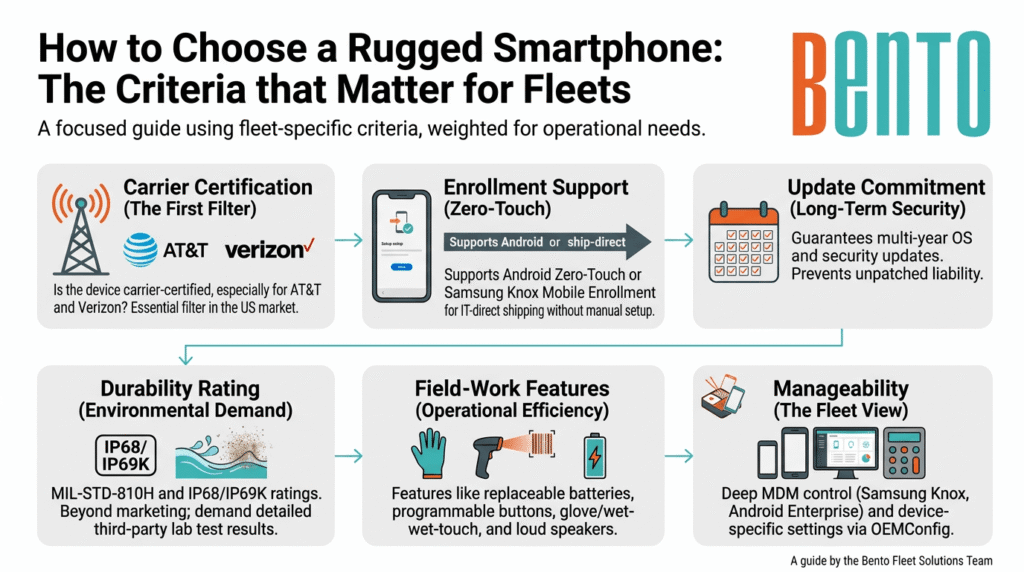
Carrier certification. Does the device work on the carriers the fleet uses, including AT&T and Verizon where needed? This is the first filter in the US market, and it eliminates a large share of low-cost rugged phones before any other factor is considered.
Enrollment support. Can the phone enroll into management automatically at first boot? Rugged Android phones from major vendors support Android Zero-Touch or Samsung Knox Mobile Enrollment, which let IT ship a device straight to the field without touching it. A rugged phone without a zero-touch enrollment path costs staff time on every unit.
Update commitment. How many years of OS and security updates does the manufacturer guarantee? Field deployments run long, so a device with a short update horizon becomes an unpatched liability partway through its service life. This factor separates enterprise-grade rugged phones from disposable ones.
Durability rating. What does the environment actually demand? MIL-STD-810H and an IP68 or IP69K rating are the baselines to look for, but the more useful question is which specific tests the manufacturer performed. Established vendors test using multiple methods through third-party labs; smaller brands sometimes treat certification as a marketing badge. Ask what was tested, not just whether the label appears.
Field-work features. Rugged phones earn their place through features a standard phone lacks: replaceable batteries for multi-shift use, programmable keys for push-to-talk or barcode scanning, glove and wet-touch screen support, and loudspeakers for noisy environments. Match the feature set to the actual work.
Manageability. How cleanly does the device sit inside an MDM console alongside the rest of the fleet? Samsung Knox and Android Enterprise give deep management control, and dedicated enterprise vendors expose device-specific controls through OEMConfig. This is where a rugged phone becomes a manageable asset rather than a tough gadget.
The Best Rugged Smartphones for Business in 2026
The picks below are grouped by the job they do best: mainstream fleet deployment, field-first heavy-duty work, carrier-specific scenarios, and dedicated enterprise handhelds. Each entry covers what it is good for, carrier support, and the enrollment path, because those are the factors a fleet decision turns on.
1. Samsung Galaxy XCover7 Pro: the fleet default
The Galaxy XCover7 Pro is the rugged smartphone most businesses should default to. It is the rare rugged phone that works across all three major US carriers (AT&T, T-Mobile, and Verizon), carries Samsung’s long update commitment, and feels like a normal phone rather than a brick. For a fleet, that combination removes the two biggest rugged-phone headaches at once: carrier lock-in and short support windows.
In terms of durability, it is IP68-rated and MIL-STD-810H-compliant, and it retains a user-replaceable battery, which is genuinely useful for multi-shift deployments where a dead battery cannot take a device out of service. For fleet management, the decisive advantage is Samsung Knox and Android Enterprise support, which provide deep management control and reliable enrollment. It also offers programmable XCover keys for push-to-talk or scanning, as well as glove and wet-touch screen support. This is the safe pick for most rugged fleets.
Best for: general rugged fleet deployment across any US carrier.
Enrollment: Samsung Knox Mobile Enrollment or Android Zero-Touch.
2. Samsung Galaxy XCover6 Pro: the value fleet pick
Where the XCover7 Pro is the current flagship, the XCover6 Pro remains the best value for equipping large teams. It carries the same core fleet strengths: Samsung Knox security for clean MDM integration, a replaceable battery, and glove-friendly touch, at a lower per-device price that matters when deployments run into hundreds of units.
For organizations standing up a large, rugged fleet for standard field tasks rather than the newest hardware, the XCover6 Pro is the sensible choice. Confirm the specific update support window at purchase, since it is shorter than that of the newer XCover7 Pro, and weigh it against the deployment length.
Best for: large-team rugged deployments where value matters.
Enrollment: Samsung Knox Mobile Enrollment or Android Zero-Touch.
3. Sonim XP10: the field-first heavy-duty pick
Sonim is one of the most field-first rugged brands, and the XP10 is built for harsh work environments where downtime is costly. It is 5G-capable, certified across all three major US carriers, and designed around reliability rather than flash: loud audio for noisy sites, tactile buttons usable with gloves, and construction meant to survive sustained abuse.
For fleets, the XP10 runs Android with Android Enterprise support, so it enrolls and manages like other Android devices while offering the field-hardened build Sonim is known for. It is the pick for construction, utilities, first-response, and industrial settings where survivability and audio clarity take precedence over the need for a premium display.
Best for: construction, utilities, first response, and heavy industrial fieldwork.
Enrollment: Android Zero-Touch with Android Enterprise.
4. Sonim XP Pro 5G: the connected field flagship
The Sonim XP Pro 5G sits above the XP10 as Sonim’s connected field flagship, offering 5G across all three major carriers and a feature set designed for demanding field deployments. It targets the same buyer as the XP10 but for teams that want more performance and connectivity headroom in the device.
Like the rest of the current Sonim line, it runs Android with Android Enterprise support, so it fits cleanly into a managed fleet. Where a team needs both Sonim-grade toughness and current connectivity, the XP Pro 5G is the stronger of the two Sonim picks, at a higher price.
Best for: field teams needing maximum toughness with current 5G connectivity.
Enrollment: Android Zero-Touch with Android Enterprise.
5. Kyocera DuraForce and DuraSport: the Verizon-optimized pick
Kyocera’s DuraForce and DuraSport rugged lines are well established in US field deployments and are particularly strong on Verizon, where the DuraForce line has historically been optimized for the network. They carry MIL-STD-810H durability and IP68 water and dust resistance, with the practical field features (loudspeakers, programmable keys, glove touch) that define the category.
For fleets, the Kyocera line runs Android and supports Android Enterprise enrollment, so it manages consistently alongside other Android devices. It is the natural pick for Verizon-based field organizations, and worth shortlisting wherever Verizon coverage is the deciding factor. Confirm the current model and its exact update commitment at purchase, since Kyocera refreshes the line periodically.
Best for: Verizon-based field fleets in outdoor and industrial roles.
Enrollment: Android Zero-Touch with Android Enterprise.
6. Zebra rugged handhelds: the dedicated enterprise tier
For warehouse, logistics, and scanning-intensive deployments, dedicated enterprise handhelds from Zebra sit a tier above general rugged phones. Zebra’s rugged mobile computers are built for enterprise data capture, with integrated barcode scanning and a design meant to be managed at scale rather than used as personal phones.
The management consideration here is OEMConfig. Zebra exposes device-specific controls (scanner behavior, key mapping, update policy) through its OEMConfig app and Zebra Enrollment Manager, so an MDM that supports Zebra OEMConfig can configure the hardware, not just enroll it. For scanning-driven warehouse and logistics fleets, this tier is the right answer, and verifying OEMConfig depth on the specific model is essential before purchase.
Best for: warehouse, logistics, and scanning-intensive enterprise fleets.
Enrollment: Zebra Enrollment Manager with Android Zero-Touch; managed through Zebra OEMConfig.
Rugged smartphone comparison at a glance
The table below compares the picks by the factors a fleet decision turns on: US carrier support, best-fit role, enrollment path, and a defining fleet feature.
| Device | US carriers | Best for | Enrollment path | Fleet note |
|---|---|---|---|---|
| Galaxy XCover7 Pro | AT&T, T-Mobile, Verizon | General rugged fleet default | Samsung Knox or Android Zero-Touch | Replaceable battery, long updates |
| Galaxy XCover6 Pro | AT&T, T-Mobile, Verizon | Value large-team deployment | Samsung Knox or Android Zero-Touch | Best value for volume |
| Sonim XP10 | AT&T, T-Mobile, Verizon | Heavy-duty field work | Android Zero-Touch, Android Enterprise | Field-first build, loud audio |
| Sonim XP Pro 5G | AT&T, T-Mobile, Verizon | Toughness with current 5G | Android Zero-Touch, Android Enterprise | Connected field flagship |
| Kyocera DuraForce / DuraSport | Verizon-optimized | Verizon field fleets | Android Zero-Touch, Android Enterprise | Strong on Verizon network |
| Zebra rugged handhelds | Carrier varies by model | Warehouse and scanning | Zebra Enrollment Manager, OEMConfig | Integrated scanning, OEMConfig depth |
Understanding rugged ratings: MIL-STD-810H and IP codes
Two certifications define the rugged category, and understanding what each does and does not guarantee helps a fleet buyer read past the marketing.
MIL-STD-810H is a US military standard covering environmental durability across many test methods: drops, vibration, temperature extremes, humidity, dust, and more. The important caveat is that it is a testing methodology, not a pass-fail certificate. A manufacturer chooses which methods to test and at what levels, so MIL-STD-810H compliance means different things on different devices. Ask which specific methods were tested.
IP ratings describe sealing against solids and liquids. IP68 means complete dust protection and water submersion resistance to a defined depth and time; IP69K adds resistance to high-pressure, high-temperature water jets, which matters in settings that use pressure washing. For most field fleets, IP68 is the baseline; IP69K is worth seeking where the environment demands it.
The practical takeaway for a fleet buyer: treat the ratings as a filter, then verify the specific tests and, ideally, run a short real-world drop-and-seal check on a sample unit before committing to volume.
Managing a rugged smartphone fleet: what happens after purchase
Choosing the device is the first decision. Managing the fleet is the recurring one, and it is where the real cost of ownership lives. Rugged phones are enrolled, configured, secured, and monitored through a Mobile Device Management platform, the same way any other corporate device is.
Rugged fleets have management needs a standard phone fleet does not. Devices are often shared across shifts rather than assigned to one person, so shared-device configuration matters. Many are locked to a single app or a small, approved set via kiosk mode, so the worker sees only the tools the job requires. Field devices go offline in dead zones and need policies that survive intermittent connectivity. And rugged Android hardware often exposes device-specific controls, such as scanner and push-to-talk-key behavior, through OEMConfig, which the MDM configures.
A cross-platform MDM matters because most real fleets are mixed. A field organization might run Galaxy XCover7 Pro units for technicians, Zebra handhelds in the warehouse, and standard phones and tablets elsewhere. Managing each in a separate tool is a recurring operational tax. Cross-platform MDMs, including Bento MDM, manage Android rugged devices alongside iOS, macOS, and Windows from a single console, keeping a mixed fleet manageable as it grows.
Which rugged smartphone fits your fleet?
Match the device to the fleet profile and the work it does, then to the carrier and management model that fit the existing environment.
| Fleet profile | Recommended device |
|---|---|
| General rugged fleet, any US carrier | Samsung Galaxy XCover7 Pro, managed through Samsung Knox |
| Large rugged fleet on a budget | Samsung Galaxy XCover6 Pro, managed through Samsung Knox |
| Heavy-duty field work (construction, utilities) | Sonim XP10 or XP Pro 5G |
| Verizon-based field fleet | Kyocera DuraForce or DuraSport |
| Warehouse and scanning-intensive | Zebra rugged handheld, managed through OEMConfig |
| Shift-shared field devices | Any of the above in kiosk mode with shared-device configuration |
| Mixed device fleet | Any of the above, managed from one cross-platform MDM console |
Cross-platform MDMs, including Bento MDM, manage rugged Android smartphones alongside the rest of the fleet from a single console, handling automatic enrollment, security policies, kiosk lockdown, OEMConfig-based hardware settings, and compliance monitoring. The device choice sets the hardware and the carrier fit; the MDM sets how manageable that hardware is across its deployment life. The right evaluation pairs the device shortlist above with a management pilot on the actual hardware, not a spec-sheet comparison alone.
Frequently asked questions
For most businesses, the best rugged smartphone is the Samsung Galaxy XCover7 Pro. It works across all three major US carriers, carries a long update commitment, keeps a replaceable battery for multi-shift use, and supports Samsung Knox for clean MDM integration. The best choice depends on the fleet: the Sonim XP10 leads heavy-duty field work, Kyocera DuraForce is strong on Verizon, and Zebra handhelds lead warehouse and scanning deployments.
The Samsung Galaxy XCover7 Pro is the best all-round rugged Android phone for fleet deployment, with three-carrier support, Samsung Knox and Android Enterprise management, and a long update commitment. For large deployments on a budget, the Galaxy XCover6 Pro is the value pick. For heavy-duty field work, the Sonim XP10 and XP Pro 5G are field-first alternatives. All enroll cleanly through Samsung Knox Mobile Enrollment or Android Zero-Touch.
No. Bullitt Group, the company that built CAT (Caterpillar) rugged phones, entered administration in January 2024 and was fully liquidated in 2025. No new CAT phones have shipped since late 2023, and official support and firmware channels are offline. For a fleet, a device without manufacturer support or security updates is not viable. The same applies to the Bullitt-built Motorola Defy rugged line. Choose a supported vendor such as Samsung, Sonim, Kyocera, or Zebra instead.
Some do, many do not. Samsung Galaxy XCover models and Sonim phones are certified across AT&T, T-Mobile, and Verizon. Many low-cost rugged brands (Ulefone, Blackview, AGM, Oukitel) work only on T-Mobile in the US, and AT&T actively blocks uncertified devices through an IMEI whitelist. Kyocera DuraForce is optimized for Verizon. Always confirm carrier certification for the specific model before a fleet purchase, since this is the factor that eliminates the most options.
MIL-STD-810H is a US military environmental-durability testing standard covering drops, vibration, temperature, dust, and more. It is a testing methodology, not a pass-fail certificate, so ask which specific methods a manufacturer tested. IP68 describes sealing: complete dust protection and water submersion resistance to a defined depth and time. IP69K adds resistance to high-pressure, high-temperature water jets. For most fleets, IP68 plus MIL-STD-810H is the baseline, with IP69K sought where the environment demands it.
Businesses manage rugged phone fleets through a Mobile Device Management (MDM) platform. The MDM enrolls devices automatically at first boot (through Samsung Knox Mobile Enrollment or Android Zero-Touch), deploys apps and configuration, enforces security policy, locks devices to specific apps through kiosk mode, configures hardware controls through OEMConfig on supported devices, and monitors compliance. A cross-platform MDM manages rugged Android devices alongside iOS, macOS, and Windows from a single console, keeping a mixed field fleet manageable.
For dedicated industrial and warehouse work, purpose-built enterprise handhelds from Zebra are built for sustained data capture and scanning, and are managed at scale through OEMConfig. Among rugged phones, Sonim devices such as the XP10 are among the most field-hardened, built for construction, utilities, and first response. The right answer depends on whether the work is scanning-intensive (Zebra) or general heavy-duty field use (Sonim), and on the carrier the fleet runs on.

Related Articles


